Showing posts with label Politics. Show all posts
Showing posts with label Politics. Show all posts
Monday, 16 July 2018


Monday, 7 May 2018

Thursday, 8 March 2018

Wednesday, 7 March 2018
International Women's Strike: 8 March 2018

The International Women’s Strike is a network of women in more than 50 different countries that emerged through planning a day of action for March 8th, 2017.
In the spirit of that renewed radicalism, solidarity and internationalism, the International Women’s Strike US continues to be a national organizing center by and for women who have been marginalized and silenced by decades of neoliberalism directed towards the 99% of women: working women inside and outside of the home, women of color, Native women, disabled women, immigrant women, Muslim women, lesbian, CIS, queer and trans women.
We see our efforts as part of a new international feminist movement that organizes resistance not just against Trump and his misogynist policies, but also against the conditions that produced Trump, namely the decades long economic inequality, criminalization and policing, racial and sexual violence, and imperial wars abroad.
We aim to build relationships of solidarity between diverse organizations of women, and all those who seek to build a global feminist, working class movement.
Sunday, 25 February 2018
The Shape of Water and the politics of cinema

Guillermo del Toro, quoted in Playback: Guillermo del Toro on ‘The Shape of Water’ and Taking a Political Stance in Art, by Kristopher Tapley, Variety
We told a story not through the agents and the scientists, but through the janitors, the cleaning women who had to wipe the toilets, emptying the trash bins, and from that moment, you are already taking a political stance.
Guillermo del Toro, quoted in Guillermo del Toro Explains How The Shape of Water Is About ‘The Beauty of the Other’, by Scott Huver, Vulture
[The amphibious creature] represents ‘the other.’ We’re living in a time where we demonize the Other. We are told we’ve got to fear. [We’re being told] everywhere, constantly, why we have to divide the world between ‘us’ and ‘them,’ whether race, religion, government [,] sexual preference, gender — anything that creates this fake division between us and them, and there’s only us. [...]
The movie tries to embody the beauty of the Other [...] What makes us different is what makes us great. It’s sort of Beauty and the Beast in a way that shows you that Beauty doesn’t have to be the perfect princess, she doesn’t have to look like a perfume-commercial model … and the Beast doesn’t have to be transformed to be loved, and he doesn’t have to turn into a boring fucking prince and renounce the essence of who he is. [...] Because, to me, love is not transformation. [...] Love is acceptance and understanding.
Excerpt from Guillermo del Toro's speech at the 2018 Golden Globes
Since childhood, I’ve been faithful to monsters. I have been saved and absolved by them, because monsters, I believe, are patron saints of our blissful imperfection, and they allow and embody the possibility of failing.
Monday, 22 January 2018


Saturday, 23 December 2017
Jean Rhys: Good Morning, Midnight

Well, let's argue this out, Mr Blank. You, who represent Society, have the right to pay me four hundred francs a month. That's my market value, for I am an inefficient member of Society, slow in the uptake, uncertain, slightly damaged in the fray, there's no denying it. So you have the right to pay me four hundred francs a month, to lodge me in a small, dark room, to clothe me shabbilly, to harass me with worry and monotony and unsatisfied longings till you get me to the point when I blush at a look, cry at a word. We can't all be happy, we can't all be rich, we can't all be lucky – and it would be so much less fun if we were. Isn't it so, Mr Blank? There must be the dark background to show up the bright colours. Some must cry so that the others may be able to laugh the more heartily. Sacrifices are necessary. ... Let's say that you have this mystical right to cut my legs off. But the right to ridicule me afterwards because I am a cripple – no, that I think you haven't got. And that's the right you hold most dearly, isn't it? You must be able to despise the people you exploit. But I wish you a lot of trouble, Mr Blank, and just to start off with, your damned shop's going bust. Alleluia!
Excerpt from Good Morning, Midnight (1939/2000, Penguin, pp. 15-16)
Thursday, 26 October 2017

Thursday, 12 October 2017
Barbara Kruger: Forever

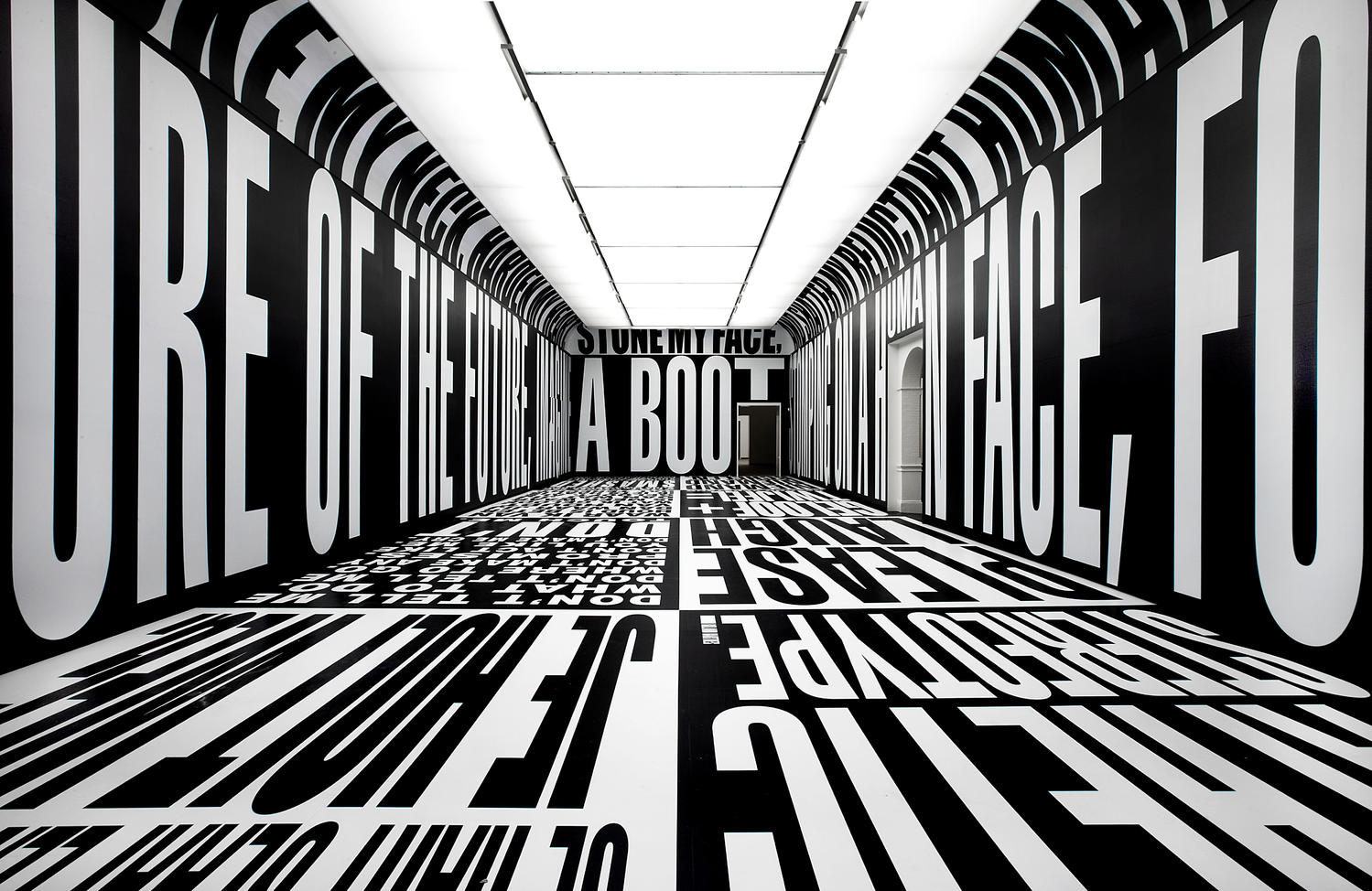
Quote from A Room of One's Own by Virginia Woolf
Women have served all these centuries as looking-glasses possessing the magic and delicious power of reflecting the figure of man at twice its natural size.
If you want a picture of the future, imagine a boot stamping on a human face — forever.
Wednesday, 12 July 2017
The 1000 Gestalten protest at the G20 summit

Excerpt from 1000 GESTALTEN at G20-summit: get rid of your shells!
The crusted shapes shall represent a society that has lost their believe in solidarity and in which everyone fights for their own progress only. In the course of the performance they dropped off their grey costumes where underneath their colorful t-shirts appeared. In this way they symbolically freed themselves from their petrified structures. [...]
Our campaign is a further symbol for the fact that many people do not want to put up with the destructive impact of capitalism any longer. What will save us in the end is not our account balance but someone who will offer their holding hand.

Saturday, 8 July 2017
Capitalism kills: protest against the G20 summit

Excerpt from Hamburg City Strike- Call
Day by day, we become witnesses of a policy that is publicly expressed at the G20 summit in July. Our life is characterized by a growing precariousness, which has long since expanded beyond our working lives. Social welfare is decimated bit by bit, public space is increasingly privatized, and austerity policy propagates the lack of alternatives to these and other measures. In order to keep the wheel of capitalism running, and to draw profits despite the growing crises, our social living conditions are increasingly becoming the goal of exploitation.
As the promises of growth and prosperity cannot be fulfilled any more even in the Metropolises, which causes modification of the state and society’s regulation framework, right-wing populism, militant nationalism and authoritarian paradigms are thriving in Europe, the US and Asia. Economic-political protectionism as well as the eviction of migrants including the construction of border fences are called for. Internally, anything not fitting the norm, anything queer or just non-conformist is under suspicion.


Friday, 23 June 2017
Art and social protest: Words Fly Away | Söz Uçar

The short film Words Fly Away (Söz Uçar) was directed by Tufan Taştan and is based on a story by Barış Bıçakçı. It refers to Nuriye Gülmen, a professor of literature, and Semih Özakça, a primary school teacher, who are on hunger strike to protest against the dismissal from their jobs and have been arrested and detained by the police in Turkey, as well as to Veli Saçılık, a sociologist, who has also been dismissed and was attacked by the police and hit with dozens of plastic bullets while protesting.
Kitaplardan geliyorlar | They flourished from books
"Nuriye, Semih, Veli..."


Monday, 1 May 2017
The Worker’s Maypole: Andrea Bowers
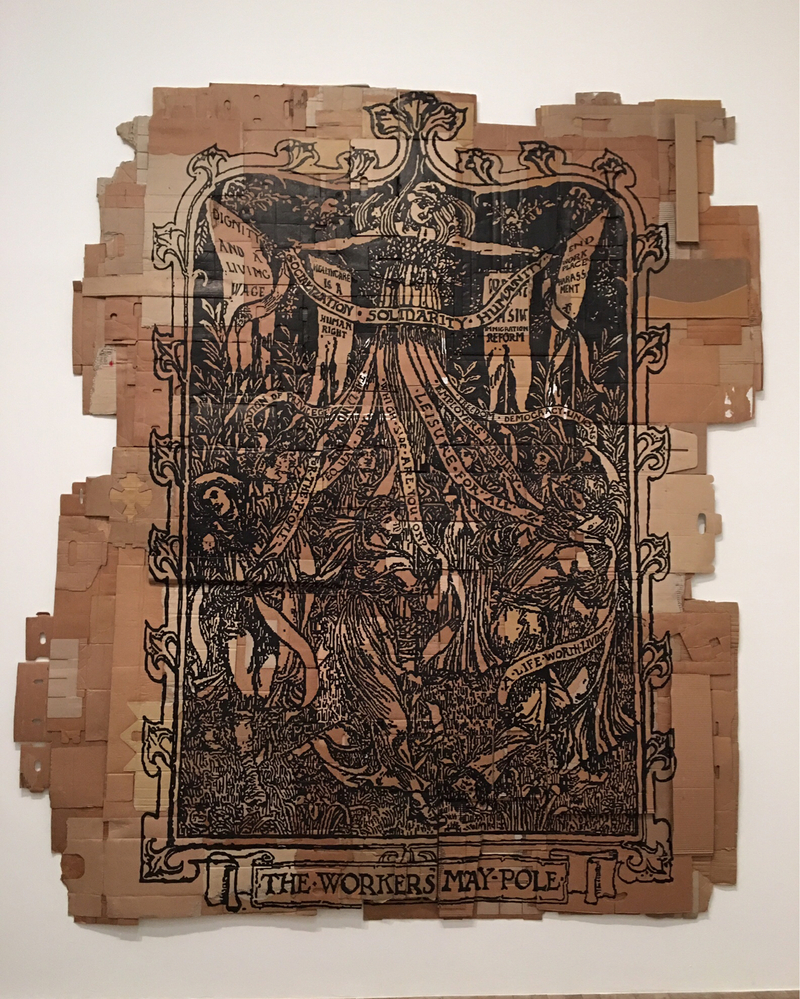
Excerpt from the summary by Mark Godfrey, Tate:
It is part of a larger body of work that Bowers started in 2012 using the same materials, which she chose to reflect those she saw being used that year in the Occupy encampments in New York, across the United States and elsewhere around the world, in protests against social and economic inequality. [...]
Bowers’s work addresses contemporary political concerns through its use of everyday, inexpensive materials (in this case, reclaimed cardboard and permanent marker pen) and through slogans and questions which address the viewer directly. At the same time, she reflects on the historical precedents of current political campaigns in her choice of source material. Bowers also celebrates a continuity of political activism that links her work to a moment in the 1890s – represented by Walter Crane – just as Crane anchored his socialist message in the folk imagery of historical rural England. By making a link to both of these historical periods, Bowers shows that while some of the causes she discusses are prompted by very contemporary crises, the rights she demands are universal and timeless.
Friday, 7 April 2017

Friday, 24 March 2017
Remembering Audre Lorde

Excerpt from The master's tools will never dismantle the master's house
Those of us who stand outside the circle of this society's definition of acceptable women; those of us who have been forged in the crucibles of difference -- those of us who are poor, who are lesbians, who are Black, who are older -- know that survival is not an academic skill. It is learning how to take our differences and make them strengths. For the master's tools will never dismantle the master's house. They may allow us temporarily to beat him at his own game, but they will never enable us to bring about genuine change. And this fact is only threatening to those women who still define the master's house as their only source of support.
Sunday, 15 January 2017

Friday, 2 December 2016
Standing up against prejudice: James Joyce

But it's no use, says he. Force, hatred, history, all that. That's not life for men and women, insult and hatred. And everybody knows that it's the very opposite of that that is really life.
What? says Alf.
Love, says Bloom. I mean the opposite of hatred.
In a crucial scene in Ulysses, when he’s assaulted by a rabidly anti-Semitic Dubliner, Bloom does retort, “Your God was a jew. Christ was a jew like me.” But later in the day, when he recounts this incident, Bloom admits that he was pretending to be Jewish—pretending to be what the nameless Dubliner assumed him to be—in order to stand up personally against the forces of prejudice: “So I without deviating from plain facts in the least told him his God, I mean Christ, was a jew too and all his family like me though in reality I’m not.”
Joyce spreads the evidence regarding Bloom’s relationship to Judaism far and wide, making it difficult to synthesize and allowing his readers to misread Bloom’s identity, just as the citizens of Dublin do. But Joyce is not playing games; Joyce is never merely playing games. He didn’t simply write a book about prejudice; he wrote a book that embodies in its language the ways in which prejudice is perpetuated, carried aloft by language, regardless of the facts. Language alters reality in Ulysses, conferring an identity on Bloom, an identity that in a moment of selfless nobility Bloom embraces as his own.
Tuesday, 6 September 2016
A prison of measured time

From Agitate! Educate! Organize!: American Labor Posters
by Lincoln Cushing and Timothy W. Drescher
Source: art & social movements
Tuesday, 10 May 2016

![[Vimeo]](https://i.vimeocdn.com/video/624794797.jpg?mw=1920&mh=1080&q=70)
![[Wikipedia]](http://en.wikipedia.org/wiki/James_Joyce#mediaviewer/File:Revolutionary_Joyce_Better_Contrast.jpg)
Tuesday, 19 April 2016
Just the sky: Patti Smith on art, life and politics

This video is an excerpt from Patti Smith's interview at the 2012 Louisiana Literature festival in Denmark; the full interview is available here.
See also:
Subscribe to:
Posts (Atom)