Showing posts with label Comics. Show all posts
Showing posts with label Comics. Show all posts
Wednesday, 28 February 2018


Tuesday, 9 January 2018


Thursday, 20 July 2017


Thursday, 1 June 2017




Wednesday, 12 April 2017


Thursday, 10 March 2016
Living in a panel: Quino

"Problem: the black pieces play and checkmate whenever they feel like it"
The kind of ideas that he works with are one of the most difficult, and I am amazed at their variety and depth. Also, he knows how to draw, and to draw in a funny way. I think that he is a giant.
Charles M. Schulz, quoted in Wikipedia
Tuesday, 9 February 2016
Living in a panel: Dave McKean

I had started making notes for a collection of short stories, but they all seemed to exist in the same place, and many of the characters seemed to relate to each other. Also, at the time, there was an interesting air of independence among the illustrators and writers who started work in the 80’s. The distribution system was quite good, so there was no NEED for a Marvel or DC. Why are we giving away the rights, control and most of the income from our creations? Plus, I knew I wanted to do something that was more experimental than anything DC were interested in, and I wanted to expand into a few hundred pages, not just 64 or 96, in order to pay close attention to how my characters talked and moved and thought.
Dave McKean interviewed by Pádraig Ó Méalóid, Forbidden Planet Blog
See also:
Wednesday, 23 December 2015


Wednesday, 7 October 2015
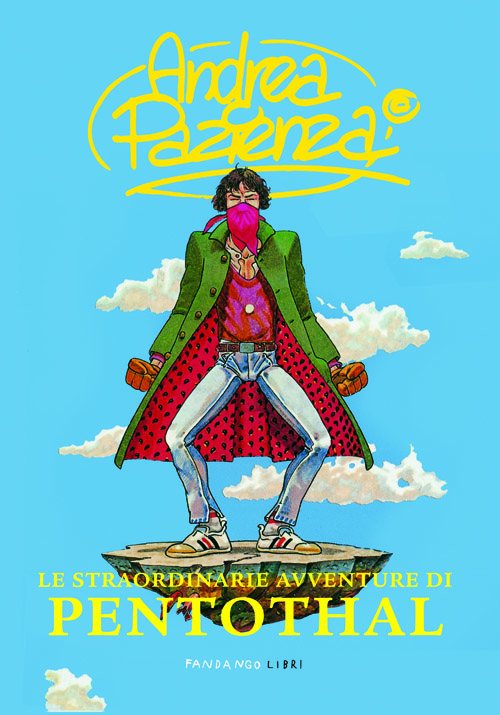
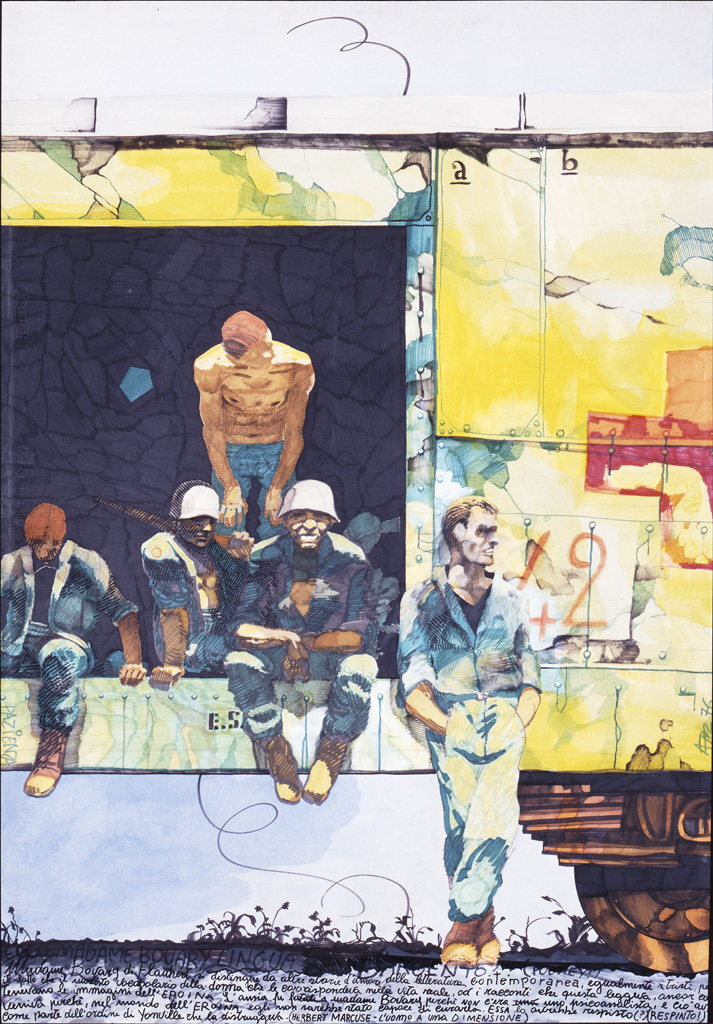
Living in a panel: Andrea Pazienza

The text reads as follows:
Dedicated to all those who were twenty years old in '77, and now are eighteen
And it refers to the Movement of 1977
Friday, 25 September 2015

Wednesday, 26 August 2015

Tuesday, 28 July 2015

Tuesday, 9 June 2015

Wednesday, 3 June 2015

Saturday, 30 May 2015
Charles M. Schulz: Peanuts in the rain

[I]f 'poetry' means the capacity of carrying tenderness, pity, wickedness to moments of extreme transparence, as if things passed through a light and there were no telling any more what substance they are made of, then Schulz is a poet. If poetry means fixing typical characters in typical circumstances, Schulz is a poet. If poetry means producing from everyday events, which we are accustomed to identify with the surface of things, a revelation that causes us to touch the depth of things, then, every so often, Schulz is a poet. And if poetry were merely finding a particular rhythm and improvising on it in a ceaseless adventure of infinitesimal variations, making a constantly new universe from the otherwise mechanical encounter of two or three elements, well, in this case, too, Schulz is a poet. More so than many others.
Umberto Eco (1963/1994) The world of Charlie Brown, in Umberto Eco, Apocalypse postponed, ed. Robert Lumley, Bloomington and London: Indiana University Press and the British Film Institute, p. 36


Friday, 22 May 2015


Thursday, 9 April 2015

Wednesday, 25 March 2015

Friday, 20 March 2015
The Arrival, by Shaun Tan

The experience of many immigrants actually draws an interesting parallel with the creative and critical way of looking I try to follow as an artist. There is a similar kind of search for meaning, sense and identity in an environment that can be alternately transparent and opaque, sensible and confounding, but always open to re-assessment. I would hope that beyond its immediate subject, any illustrated narrative might encourage its readers take a moment to look beyond the ‘ordinariness’ of their own circumstances, and consider it from a slightly different perspective. One of the great powers of storytelling is that invites us to walk in other people’s shoes for a while, but perhaps even more importantly, it invites us to contemplate our own shoes also. We might do well to think of ourselves as possible strangers in our own strange land.
A brief vision of the country being left behind, for reasons as mysterious as they are obvious.

Every resident of the new world has their own tale to tell and reasons to give up a life they know for one they don’t. This is one of the more dramatic tales, inspired by accounts of totalitarian persecution: a society in which complex diversity is obliterated in favour of a single “truth”.

Monday, 9 March 2015
Black and white brilliance: the art of José Muñoz


Subscribe to:
Posts (Atom)