
Stournari St., 20.03.2012 (mural by Sidron)
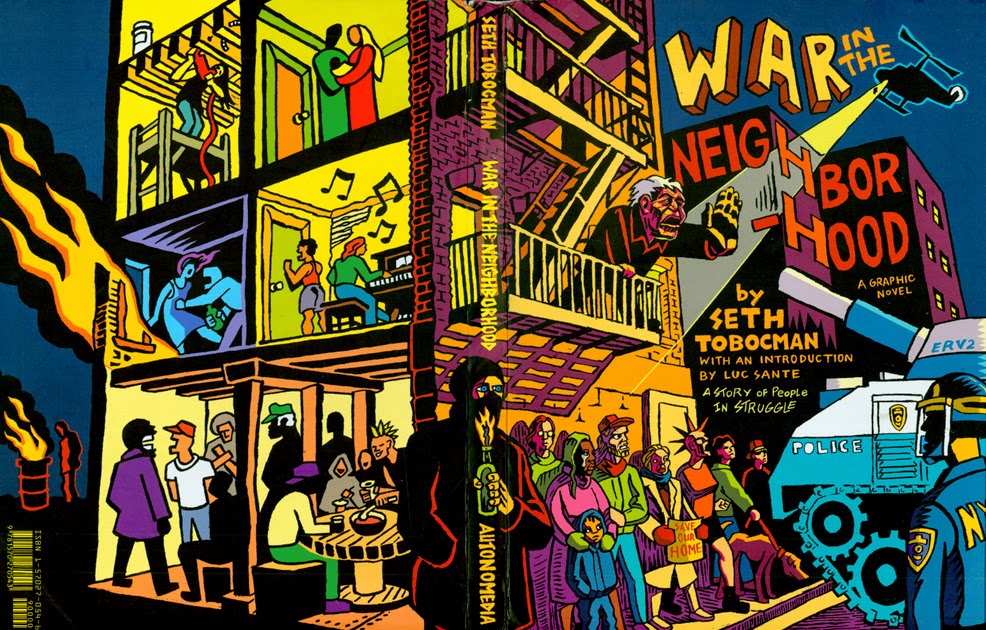

Lower East Side politics, by Seth Tobocman
I got my first real experience of political organizing when our landlord tried to impose an unjustified rent increase on our building. The residents formed a tenant union, went on rent strike, took the landlord to court and won many improvements.I became aware of the Lower East side as a community in struggle.Mayor Koch had announced that ‚"New York is a city for winners" and threatened that poor people would be pushed into the east river. There were many initiatives launched to preserve the L.E.S.. as a place where working-class and middle class folks could afford to live. One of the most inspiring was the squatters movement.In the 1980s hundreds of city owned abandoned buildings sat empty while people were freezing to death on the streets. The squatters broke into these buildings and turned them into low income housing. The squatters movement also tried to protect the rights of homeless people who lived in Tompkins Park.All of this activity led to an attempt by the city to crush the movement. But people fought back. From 1988 to 1992 there were a series of riots in the neighborhood. The Lower East Side became the focus of an international struggle for human rights.


The widening gyre of violence is terrible news for the entire region, but for none more than the 1.8 million Palestinians trapped in the battered sliver of the Gaza Strip. There, the “precision” bombs of the Israeli military have obliterated entire families of twenty and thirty; young boys have been blown apart while playing soccer on a beach; and whole neighborhoods have been leveled by the overwhelming Israeli firepower. The United Nations has estimated that as many as 74 percent of the Palestinians killed in Gaza have been civilians, with an average of one child dying every hour during one particularly bloody two-day stretch. With the borders closed and even UN schools under attack, there is simply no place for Palestinians to flee to.[...]The failure of the cease-fire proposals have left a void where impunity continues to flourish. Yet the diverse and humane currents of international civil society have been responding, issuing demands Washington is too timid to make. This includes the sixty-four Nobel laureates and public figures—among them Archbishop Desmond Tutu and Noam Chomsky—who have called for an international arms embargo on Israel. They include legal experts like John Dugard, Noura Erakat and Peter Weiss, who have demanded an end to Israel’s collective punishment in Gaza and the beginning of “procedures to hold accountable all those responsible for violations of international law.” They include Jewish groups like Jewish Voice for Peace, which has been tireless in defending Palestinian rights, and J Street, which is pressing for an end to the siege of Gaza. And they include the Palestinian civil society groups that have been steadfast in calling for nonviolent resistance by means of boycott, divestment and sanctions.The civilian population in the Gaza Strip is under direct attack and many are forced to leave their homes. What was already a refugee and humanitarian crisis has worsened with a new wave of mass displacement of civilians: the number of IDPs [internally displaced persons] has reached nearly 150,000, many of whom have obtained shelter in overcrowded UNRWA schools, which unfortunately are no safe areas as demonstrated by the repeated attacks on the UNRWA school in Beit Hanoun. Everyone in Gaza is traumatized and living in a state of constant terror.This result is intentional, as Israel is again relying on the “Dahiya doctrine,” which deliberately has recourse to disproportionate force to inflict suffering on the civilian population in order to achieve political (to exert pressure on the Hamas Government) rather than military goals.In so doing, Israel is repeatedly and flagrantly violating the law of armed conflict, which establishes that combatants and military objectives may be targeted, i.e. “those objects which by their nature, location, purpose or use make an effective contribution to military action and whose total or partial destruction, capture or neutralization, in the circumstances ruling at the time, offers a definite military advantage.” Most of the recent heavy bombings in Gaza lack an acceptable military justification and, instead, appear to be designed to terrorize the civilian population. As the ICRC clarifies, deliberately causing terror is unequivocally illegal under customary international law.[...]The indiscriminate and disproportionate attacks, the targeting of objectives providing no effective military advantage, and the intentional targeting of civilians and civilian houses have been persistent features of Israel’s long-standing policy of punishing the entire population of the Gaza Strip, which, for over seven years, has been virtually imprisoned by Israeli imposed closure.Such a regime amounts to a form of collective punishment, which violates the unconditional prohibition set forth in Article 33 of the Fourth Geneva Convention and has been internationally condemned for its illegality. However, far from being effectively opposed by international actors, Israel’s illegal policy of absolute closure imposed on the Gaza Strip has relentlessly continued, under the complicit gaze of the international community of States.


At 3am Gaza time, July 9, in the midst of Israel’s latest exercise in savagery, I received a phone call from a young Palestinian journalist in Gaza. In the background, I could hear his infant child wailing, amidst the sounds of explosions and jet planes, targeting any civilian who moves, and homes as well. He just saw a friend of his in a car clearly marked “press” blown away. And he heard shrieks next door after an explosion but can’t go outside or he’ll be a likely target. This is a quiet neighborhood, no military targets – except Palestinians who are fair game for Israel’s high tech US-supplied military machine. He said that 70% of the ambulances have been destroyed, and that by then over 70 had been killed, and of the 300 or so wounded, about 2/3 women and children. Few Hamas activists have been hit – or rocket launching sites. Just the usual victims.It is important to understand what life is like in Gaza when Israel’s behavior is “restrained,” in between the regular manufactured crises like this one. A good sense is given in a report to UNRWA by Mads Gilbert, the courageous and expert Norwegian physician who has worked extensively in Gaza, also throughout the vicious and murderous Cast Lead operation. In every respect, the situation is disastrous. Just keeping to children, Gilbert reports: “Palestinian children in Gaza are suffering immensely. A large proportion are affected by the man-made malnourishment regime caused by the Israeli imposed blockage. Prevalence of anaemia in children <2yrs in Gaza is at 72.8%, while prevalence of wasting, stunting, underweight have been documented at 34.3%, 31.4%, 31.45% respectively.” And it gets worse as the report proceeds.When Israel is on “good behavior,” more than two Palestinian children are killed every week, a pattern that goes back over 14 years. The underlying cause is the criminal occupation and the programs to reduce Palestinian life to bare survival in Gaza, while Palestinians are restricted to unviable cantons in the West Bank and Israel takes over what it wants, all in gross violation of international law and explicit Security Council resolutions, not to speak of minimal decency. And it will continue as long as it is supported by Washington and tolerated by Europe – to our everlasting shame.


