Tuesday, 20 May 2014


Saturday, 17 May 2014
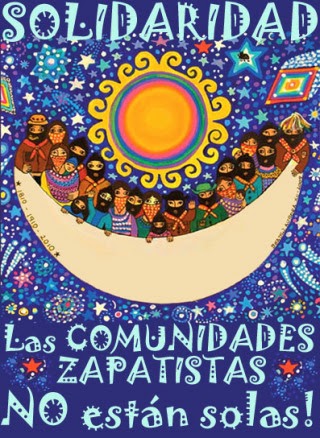
Stop the war against the Zapatista communities: London, 18 May 2014

Everyone is invited to join a demonstration this Sunday at 11 am at the Mexican Embassy in London. Let’s let the government know that the Zapatistas are not alone, that a lot of people in a lot of places are watching their actions, and that we know that compa Galeano’s murder was not due to a problem within the community, but the result of a paramilitarisation strategy that the government has implemented in Mexico, and particularly in Chiapas, for years. Let’s demand together the end of the attacks and justice for the cases of the murdered compas.Please join us and bring along any banners rejecting the murderers and supporting the Zapatistas.
See also:
Wednesday, 14 May 2014
An attack on the Zapatistas is an attack on us all
A call to action in support of the Zapatistas by intellectuals, artists, and organizations; signatories include Noam Chomsky, Junot Diaz, Alice Walker, Mike Davis, Cornel West, Angela Davis, Robin Kelley, Emory Douglas, David Harvey, Lawrence Ferlinghetti, Chris Hedges, Michael Albert, David Graeber, Michael Hardt, George Kaffentzis, Harry Cleaver, and many more.
Summary of recent events:On May 2, 2014, in the Zapatista territory of La Realidad, Chiapas, Mexico, the group CIOAC-Historico [with the participation of the Green Ecological Party and the National Action Party (PAN)], planned and executed a paramilitary attack on unarmed Zapatista civilians. An autonomous Zapatista school and clinic was destroyed, 15 people were ambushed and injured and Jose Luis Solis Lopez (Galeano), teacher at the Zapatista Little School, was murdered. The mainstream media is falsely reporting this attack on the Zapatistas as an intra-community confrontation, but in fact this attack is the result of a long-term counterinsurgency strategy promoted by the Mexican government.Given the experience of the 1997 massacre at Acteal, we are concerned about the mounting paramilitary activity against Zapatista bases of support. It is clear that if we do not take action now, the current situation in Chiapas may also lead to an even more tragic end.Why this matters to us:Since 1994, the Zapatistas have shown us the bankruptcy of the world that dominates us and, most importantly, the ability to organize ourselves into self-determining communities autonomous from the political class and capitalism. It is this capacity to show that another world is possible in the here and now, one not rooted in exploitation, dispossession, repression and de-valorization, but rather in liberty, democracy and justice, that has inspired us all. An attack on the Zapatistas is an attack on the other world that we have all tried to build along with them for the past 20 years.What we should do:We strongly denounce the murder of Compañero Galeano and the attacks against our Zapatista brothers and sisters. We denounce the deliberate destruction of the Zapatista clinic and school. We denounce the disinformation from the press regarding these attacks.To denounce these aggressions and in support of our Zapatista brothers and sisters, the signatories below call on all Zapatista supporters, students, anti-prison activists, artists, workers, intellectuals, teachers, academics, LGBTQ groups, anarchists, communities of faith, prisoners, communities and organizations of color, indigenous peoples, Chicanos, migrants and all those seeking a more just, non-capitalist world, to pronounce themselves against these attacks by the Mexican government on the Zapatistas and to hold events starting Sunday May 18th (e.g. demonstrations at Mexican consulates and Embassies, corporate subsidiaries, and banks supporting the Mexican government, teach-ins, discussion groups, concerts, informational sessions, or other civil actions that people deem appropriate for their city) and culminating with a day of remembrance on May 24th called by the Zapatistas in honor of the late Compañero Galeano.Let’s make our dignified pain and rage another building block towards a movement that will directly participate, along with the Zapatistas, in creating this new world.
See also:
Zapatista news and information:
Zapatista texts and documents:
Sunday, 11 May 2014
Systematically drowning migrants and refugees

The Mediterranean has become the grave of countless migrants fleeing war and poverty: last week yet another small vessel capsized in the North Aegean, carrying people from Syria, Somalia and Eritrea. At least twenty-two were drowned, most of them women and children; some of them died trapped underwater in the cabin. These catastrophic shipwrecks are a regular occurrence, in the Aegean and in the Mediterranean south of Italy. Last month an Amnesty International report published yet more evidence of the horrifying treatment of migrants by Greek state agents: routine illegal pushbacks across the border, sometimes by hooded men; live rounds fired at boats; beatings, threats and extreme humiliation by the coast guard and police. Amnesty calls on the EU to sanction Greece for its violations of international law, but also acknowledges the EU’s responsibility. Between 2011 and 2013 the European Commission gave Greece €227,576,503 to keep the migrants out, but only €19,950,00 to help with their reception. The EU uses its border states as a barrier and prison camp for the frightened, impoverished people it would rather drown than save. The Mediterranean is now the moat surrounding Fortress Europe.
“The treatment of refugees and migrants at Greece’s borders is deplorable. Too often, instead of finding sanctuary, they are met with violence and intimidation. There are cases where they have been stripped naked, had their possessions stolen, and even held at gunpoint before being pushed back across the border to Turkey,” said John Dalhuisen, Europe and Central Asia Programme Director.“The people carrying out these push-backs are state agents. As such, the Greek authorities bear full responsibility for their actions. The authorities must openly acknowledge and ensure an end to the illegal and often dangerous practice of push-backs.”Push-backs are collective expulsions of migrants across the border they have crossed, back to where they came from. They amount to the unlawful deportation of a group of people without consideration of individual circumstances and denying them the possibility to request asylum. Push-backs are explicitly prohibited under Greek, EU and international law.
See also:
Wednesday, 7 May 2014

Sunday, 4 May 2014
Art for social justice: Ricardo Levins Morales

In a class society such as the United States, the so-called national art scene represents the rather confined dreams of a small segment of the population. It’s considered a sacred duty for artists to remain isolated from any broad community that might influence their art. Artwork must remain personal in the narrowest sense while fitting into the moment’s specifications for saleable work. Alienation is one of the requirements. A friend told me of a Midwestern painter who finally got a favorable review of her show after having worked in New York for a couple of years. The critic was elated that, in contrast to her earlier, optimistic paintings, her new work was starting to show the “angst” (read depression) of a mature artist.
The greatest form of pressure that cuts artists off from the living currents of their communities is the designation of some subject matter as “political.” As it applies to art, “political” is a clear “no trespass” sign forbidding access to whatever the ruling elite does not wish people to think about. It varies from country to country and over time. New York artist Lisa Blackshear’s paintings of interracial couples would be politically explosive in South Africa, cause some discomfort in the United States, and not raise an eyebrow in Brazil. In South Africa, the book Black Beauty was banned, for although it is the story of a horse, the linking of the two works in its title was seen as dangerously revolutionary by the censors. In General Pinochet’s Chile, teaching evolution was seen as subversive because it described a world in which change is constant and inevitable. It is therefore seen as challenging the rigid stability preached by the dictatorship.
The “political” label -- and the funding, performance space, display and publishing decisions that enforce it -- serves to prevent artists from fulfilling their function as conveyors and interpreters of their people’s dreams.
For the majority of the potentially artistic population a form of dream suppression is practiced. Organic cultural expression is discouraged by the denial of resources and the promotion of the arts as the province of a gifted few. In the crude tracking system of the schools, an artist is whoever is left when the rest are bludgeoned into silence. Those who survive this assault on their creativity may pursue it through arts schools, where they’ll be safely taught to respect taboos.
These systems of suppression and control are far from fully effective. At best they work as damage control to limit the number of artists who survive and the imaginations of those who do. But still,artists who have been successful within the cultural industries, as well as those who develop outside of the educational system, are drawn by the gravitational pull upon the artist to explore every area of communal life.
Too often, activist artists ourselves accept the “no trespass” signs of the elite, simply choosing to set up camp on the other side of them. Thus, we miss the subversive potential coming straight from the deepest springs of artistic inspiration. If we listen and convey the dreams of our people, we will ignore the signs and property lines. If we violate the warning signs, it will be while being true to our mission as artists. To grasp the full potential of cultural creation as an arena for social transformation we must go beyond seeing ourselves as simply “political artists,” “oppositional artists,” or even “voices of dissent.”


Subscribe to:
Posts (Atom)